Strengthening OETH Staking: Security, Efficiency, and Merkle Proof Implementation
Ethereum’s liquid staking landscape is evolving quickly. While most Liquid Staking Tokens rely on oracles and older validator types, these approaches introduce inefficiencies and trust assumptions. With Origin Ether (OETH), we’ve always prioritized security and transparency — and the new OETH Staking Upgrade takes this further.
This upgrade introduces a simplified validator architecture, built-in front-run protection for deposits, and merkle proof validation against the Ethereum Beacon Chain. Together, these improvements remove reliance on third-party oracles, deliver faster withdrawals, and improve capital efficiency.
Simplified Validator Architecture
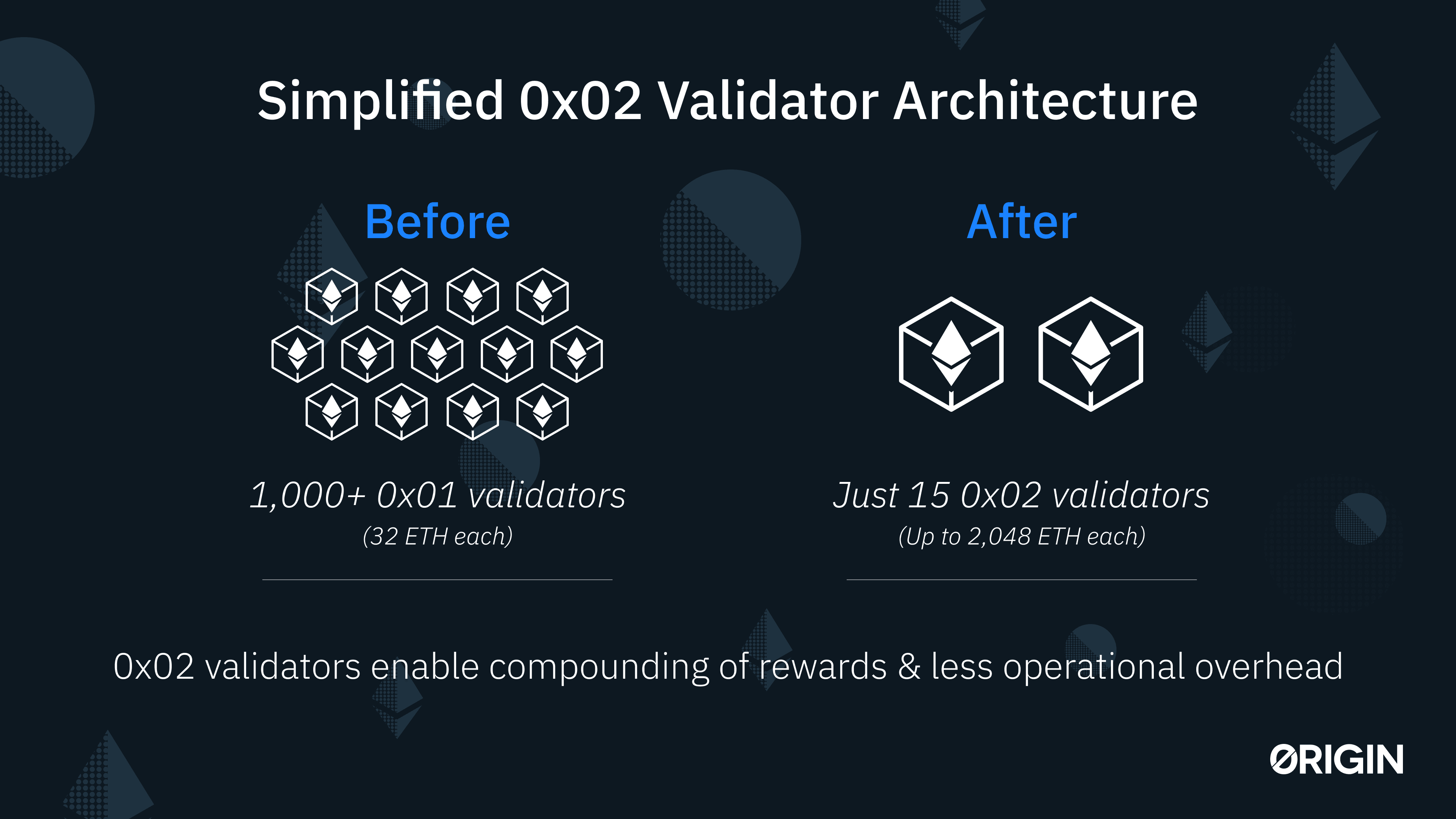
Previously, OETH managed around 1,000 sweeping validators (0x01 type). These validators required deposits in multiples of 32 ETH and relied on a sweeping cycle every 9–10 days to distribute yield or process exits.
The upgrade consolidates staking into 15 compounding validators (0x02 type). This brings multiple benefits:
- Lower costs & easier monitoring: Fewer validators mean lower upkeep and simpler reliability checks.
- Better capital efficiency: Validators can accept deposits in any amount above 1 ETH. This eliminates idle ETH that previously had to sit unused until it reached multiples of 32.
- Compounded rewards: Consensus rewards are automatically added to validator balances, increasing their effective balance in 1 ETH increments. Rewards are now put back to work faster, without waiting for new validator activations.
These improvements have been audited by OpenZeppelin, Sigma Prime, and Nethermind, ensuring that the new contracts meet the highest standards of security before being deployed.
Built-In Deposit Front-Run Protection
Validator deposit front-running — while rare — is a serious risk. If an attacker with access to a validator’s private key makes the first deposit with a different withdrawal credentials, they can permanently redirect all funds away from the intended withdrawal address.
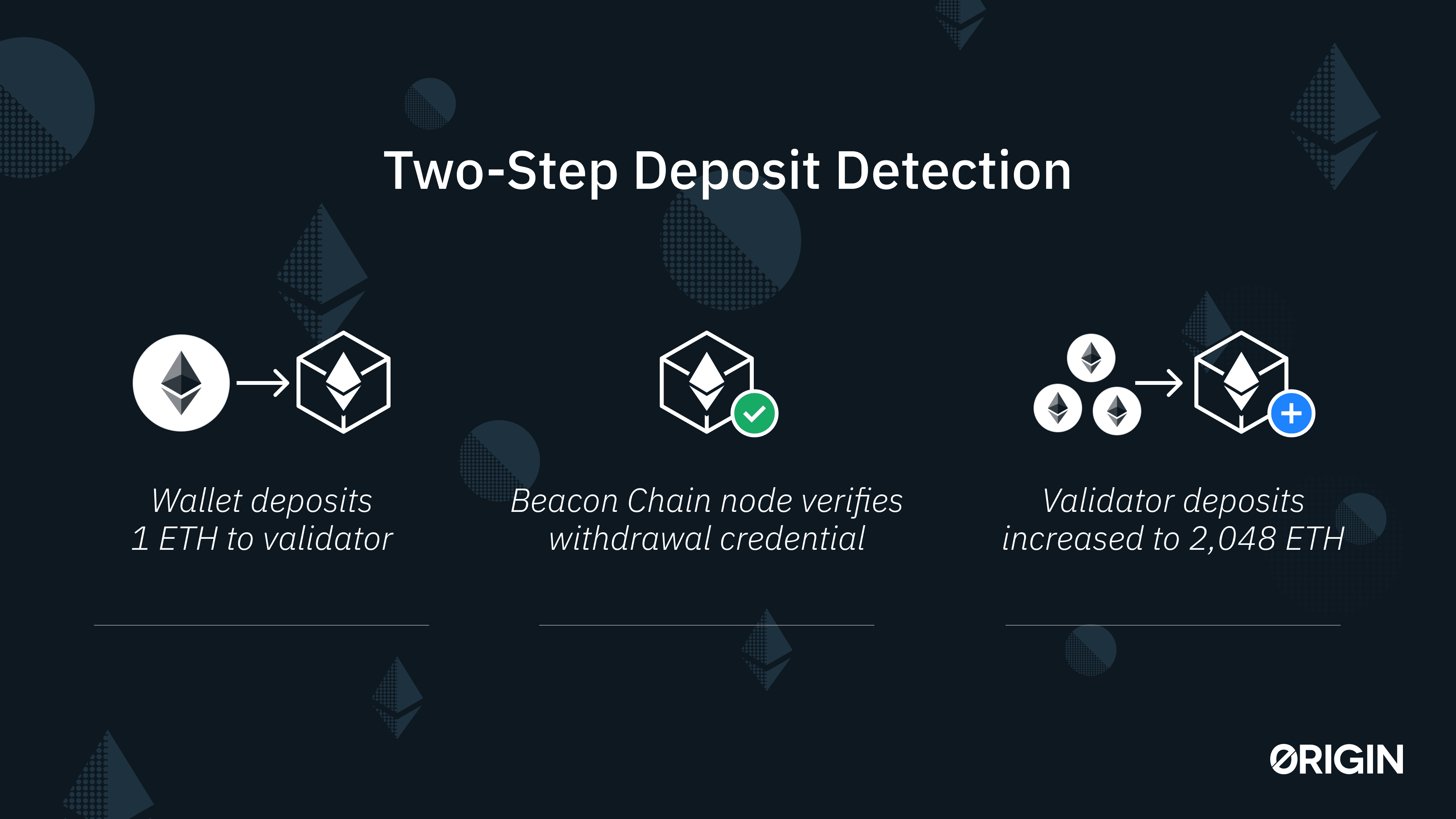
To defend against this, the new OETH staking strategy introduces a two-step deposit process:
- Initial capped deposit: The first deposit to a validator is limited to just 1 ETH.
- Merkle proof verification: Before any larger deposits can be made (up to 2,048 ETH per validator), the withdrawal credential is verified on the Beacon Chain using a merkle proof.
If verification fails — indicating a front-run or misconfigured validator — deposits are paused, and governance decides next steps, including potentially changing validator operators if the private key is compromised.
This mechanism ensures that OETH deposits cannot be hijacked, making validator onboarding trust-minimized and aligned with Ethereum’s security guarantees.
Industry-Leading Security: Merkle Proof Validation
The biggest advancement in this upgrade is native Beacon Chain validation via merkle proofs.
The LST Accounting Problem
LST contracts live on Ethereum’s execution layer, but validator balances exist on the consensus layer (Beacon Chain). Historically, this has created an accounting gap: execution-layer contracts cannot directly read validator balances.
Most LSTs bridge this gap by relying on oracles. For example, Lido’s oracle committee of nine organizations reports validator balances daily. This design has proven to be effective, but with Ethereum’s Pectra upgrade, accounting can now be done using Merkle Proofs, eliminating trust assumptions and reliance on external actors.
Our Solution
With Ethereum’s Dencun upgrade (EIP-4788), Beacon Chain roots are now available in the EVM. OETH’s new staking strategy leverages this to verify validator state:
- Validator balances are proven with Beacon Chain merkle proofs.
- Deposits are verified to be still pending or processed with Beacon Chain merkle proofs.
- Exited validators are verified to have a zero balance with Beacon Chain merkle proofs
- No external oracle is needed.
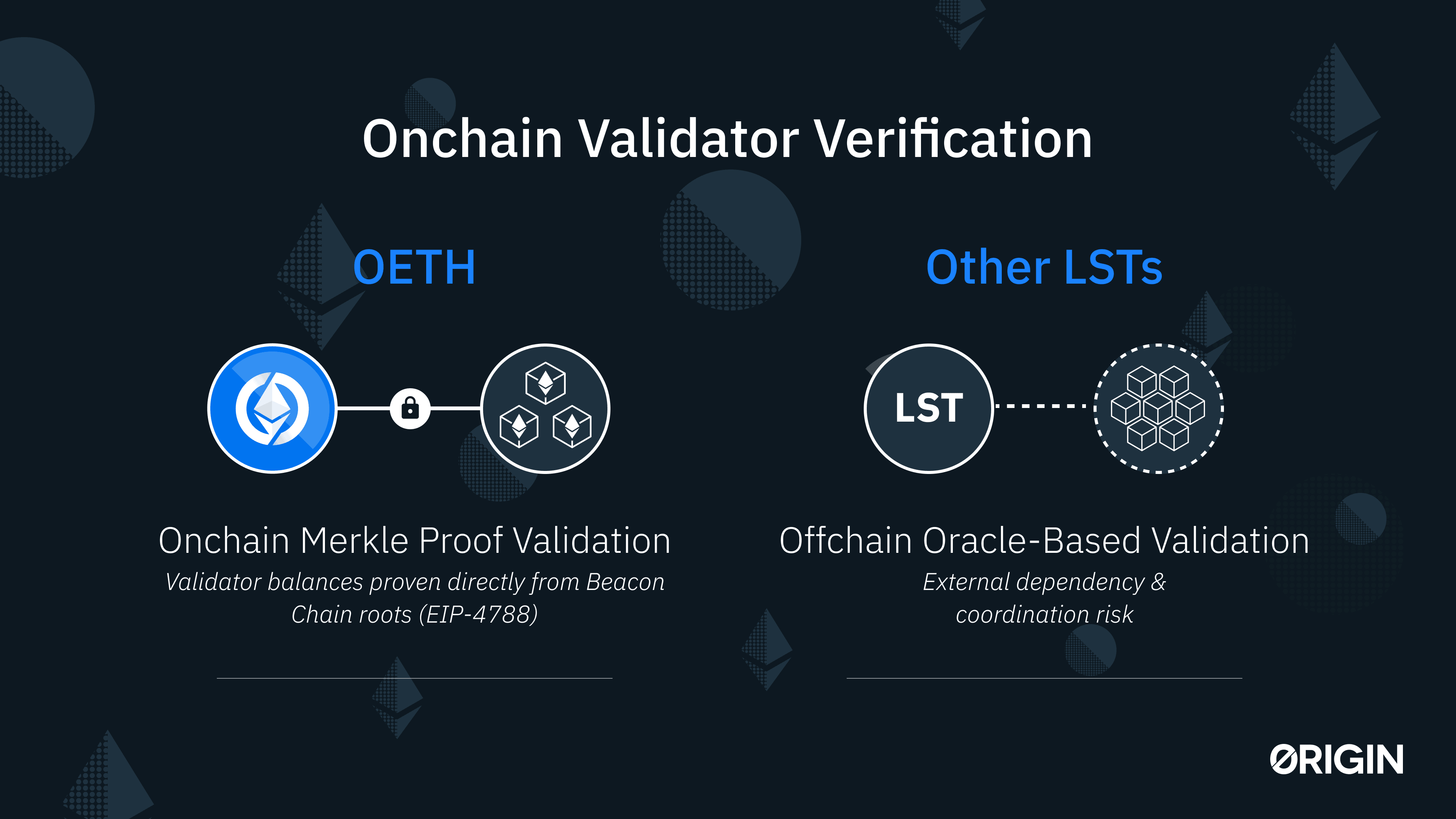
This places OETH in an elite category: only EigenLayer, StakeFish, and now Origin Ether use native merkle proof validation. By adopting this, OETH’s accounting is fully trust-minimized and cryptographically verifiable, aligning directly with Ethereum’s base security model.
Raising the Bar for Secure Staking
The OETH Staking Upgrade delivers measurable improvements for stakers:
- Security: Removal of oracle dependencies and full merkle proof validation.
- Efficiency: Compounding validators enable granular deposits and faster reinvestment of rewards.
- Withdrawals: Faster access to funds, without being tied to the 9–10 day sweeping cycle.
By combining yield generation with uncompromising security, OETH strengthens its position as one of the most advanced and reliable LSTs in the market.
This upgrade not only increases confidence for everyday users but also lays the foundation for broader adoption — from institutional players to Digital Asset Treasuries (DATs) that demand transparent, verifiable staking infrastructure.
Stake OETH today, and stay tuned as we continue to push liquid staking forward.
