The End of Oracle Dependence: How Origin Ether Brings Trustless Validation to Liquid Staking
Eliminating Oracle Dependencies in Ethereum Staking
Ethereum’s liquid staking market has matured rapidly, powering billions in onchain collateral. Yet most liquid staking protocols still rely on 3rd party oracle committees to operate, representing an architectural flaw in an ecosystem built on trustless verification.
These oracles bridge Ethereum’s execution and consensus layers, reporting validator balances and exits. The model works, but it adds offchain coordination, latency, and social trust back into a system designed to remove them.
With its latest upgrade, Origin Ether (OETH) eliminates these dependencies entirely. By verifying validator balances directly against the Ethereum Beacon Chain using Merkle proofs, OETH becomes one of the first LSTs to achieve fully trustless accounting — with no dependencies on committees or 3rd party oracles.
The Oracle Bottleneck
Liquid staking tokens live on the execution layer, while validator balances exist on the consensus layer. Historically, these two layers couldn’t communicate, forcing LST protocols to depend on oracles for validator data.
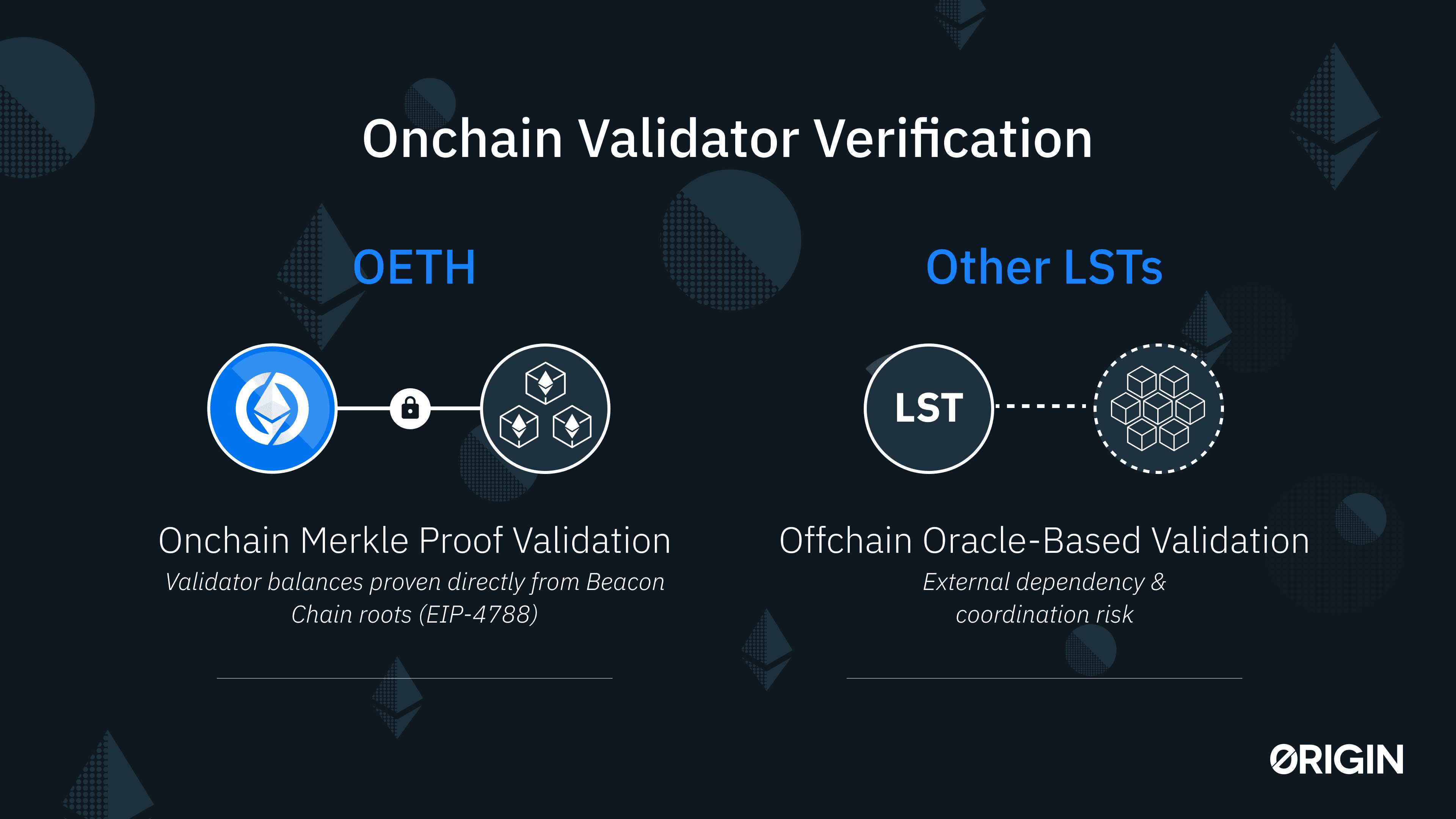
Lido, for example, relies on a nine-member committee to report validator performance every 24 hours. The system works but introduces trade-offs:
- Trust assumptions: Users depend on committee honesty and uptime.
- Update lag: Onchain accounting trails real validator performance.
- Operational overhead: Each oracle requires offchain coordination and fallback logic.
For a blockchain built around self-verification, these are fundamental limitations.
EIP-4788: A Turning Point for Ethereum
That changed with Ethereum’s Dencun upgrade and EIP-4788.
EIP-4788 exposes Beacon Chain roots inside the EVM, allowing smart contracts to verify validator states cryptographically. For the first time, execution-layer contracts can confirm validator data without relying on external actors. This upgrade turns what was once an oracle problem into a solvable, onchain process.
How Origin Ether Implements Merkle Proof Validation
OETH’s upgraded staking architecture leverages EIP-4788 to validate validator data directly. Using Beacon roots, the contracts can confirm:
- Whether validator balances have increased or decreased.
- Whether deposits remain pending or are processed.
- Whether exited validators hold a zero balance.
Every update is verified by Merkle proofs, with the contract rejecting any state change that fails validation. This design closes the accounting gap between the execution and consensus layers, replacing trust with cryptographic assurance.
All contracts were audited by OpenZeppelin, Sigma Prime, and Nethermind, ensuring security on par with Ethereum’s validator infrastructure.
Why It Matters
Replacing oracles with proofs does more than improve security. It aligns staking with Ethereum’s foundational principles.
- Resilience: Less reliance on offchain committees or periodic updates.
- Transparency: Validator balances are verifiable by anyone, using public Beacon data.
- Composability: Onchain integrations can trust deterministic accounting.
Setting a New Standard for Liquid Staking
Origin joins a short list of protocols — including EigenLayer and Stakefish — pioneering Merkle proof validation. OETH is one of the first to apply this at the liquid staking layer, giving users direct access to trust-minimized ETH staking rewards.
As the ecosystem evolves, proof-based accounting is poised to replace oracle-based systems. The same way proof-of-stake redefined consensus, proof-based validation will redefine staking transparency.
Proofs as a New Primitive
Merkle proofs are becoming a new building block for onchain finance. By allowing smart contracts to reference consensus-layer data directly, they open the door to more transparent and secure staking infrastructure, while laying the groundwork for future innovations, including:
- Restaking protocols that can verify validator state onchain without relying on offchain data relayers.
- Institutional staking and fund products that require cryptographic proof of validator performance and solvency.
- Cross-chain or modular systems that can reference Ethereum’s consensus data for settlement and collateral verification.
By adopting this architecture now, Origin Ether is setting the benchmark for what verifiable staking infrastructure should look like: secure, transparent, and directly anchored to Ethereum’s consensus.
Get started with Origin Ether today.
